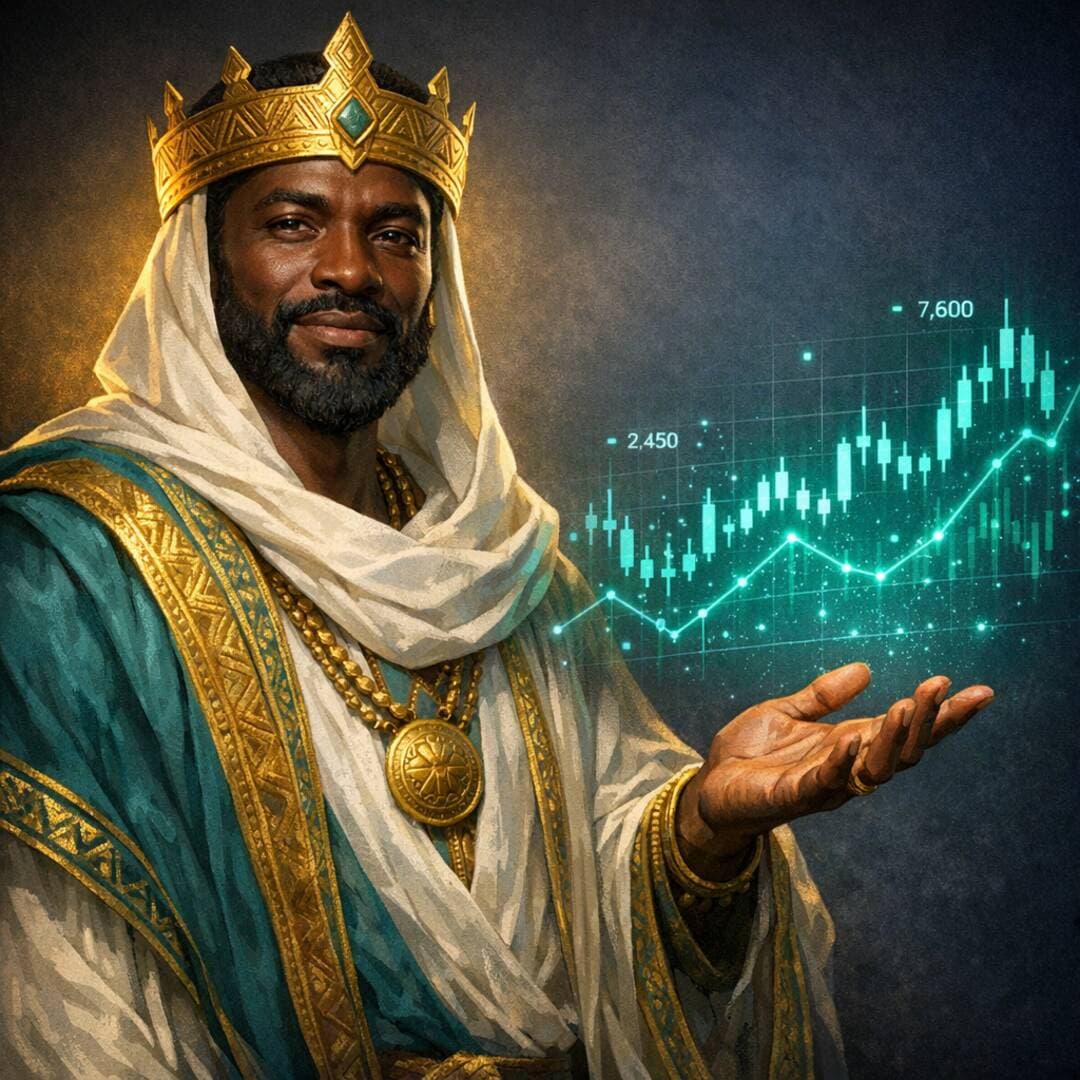
The Historical Figure Behind Mansa
Mansa Musa
Emperor of the Mali Empire. His 1324 pilgrimage to Mecca with a caravan laden with gold astonished the medieval world and cemented West Africa's place in global history.
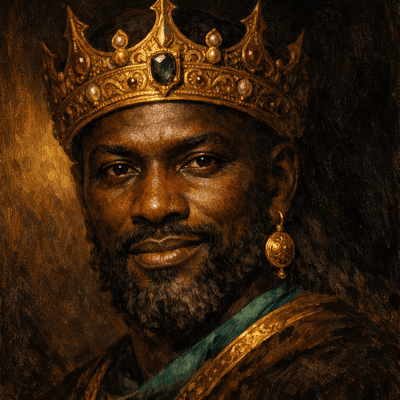
Ninth Mansa of the Mali Empire and namesake of Afrivestia's financial advisor. His 1324 pilgrimage to Mecca remains one of the most documented displays of sovereign wealth in medieval history.
Timeline
Born into the Keita dynasty of the Mali Empire
Becomes the ninth Mansa, succeeding Abu Bakr II
Expands the empire to its greatest territorial extent: secures Timbuktu, Gao, and the Taghaza salt mines
Departs for the Hajj pilgrimage to Mecca with a vast entourage
Arrives in Cairo; his lavish gold distribution astounds the Mamluk court and reportedly depresses gold prices for years
Commissions the Djinguereber Mosque in Timbuktu, built by Andalusian architect Abu Ishaq al-Sahili
Builds mosques and madrasas, invites scholars from Egypt and the Maghreb to Timbuktu and Gao
Dies after approximately 25 years of rule. Succeeded by Mansa Maghan I
Depicted holding gold on the Catalan Atlas, the most famous European map of the medieval world
The Mali Empire Under Musa
At its peak under Mansa Musa, the Mali Empire stretched from the Atlantic coast to the bend of the Niger River, encompassing parts of modern-day Mali, Senegal, Gambia, Guinea, Guinea-Bissau, Mauritania, Burkina Faso, and Niger. It was one of the largest polities in the medieval world.
Mali's wealth rested on control of the trans-Saharan trade routes. The Bambuk and Bure goldfields produced a significant share of the gold known to the medieval world. The Taghaza salt mines in the central Sahara supplied rock salt that was exchanged for gold at enormous geographic price differentials. Caravans of thousands of camels traversed the desert, carrying gold, salt, enslaved people, kola nuts, textiles, horses, and manuscripts.
Governance was a layered confederation: the Manden heartland was directly ruled, conquered provinces were administered by appointed governors (farbas), vassal states retained their rulers but paid tribute, and trade cities like Timbuktu maintained significant autonomy. The mansa's power rested on military strength (particularly cavalry), control of commerce, diplomatic networks, and Islamic legitimacy.
The Pilgrimage to Mecca (1324-1325)
The hajj pilgrimage is the single best-attested event of Musa's reign. In 1324, he departed from his capital with a vast entourage for the long journey across the Sahara to Mecca. The Syrian historian al-Umari, writing in the 1340s based on interviews with Egyptian officials who witnessed the event firsthand, provides the most detailed account.
Musa arrived in Cairo in mid-1325. He reportedly refused to prostrate himself before the Mamluk Sultan al-Nasir Muhammad, asserting that he bowed only before God — a diplomatic gesture that underscored his status as an equal sovereign. He then distributed gold with extraordinary generosity: to court officials, to the poor, and in the markets.
This man spread upon Cairo the flood of his generosity: there was no person, officer of the court, or holder of any office of the Sultanate who did not receive a sum in gold from him.
— Al-Umari, Masalik al-Absar (c. 1340)
Al-Umari records that the influx of gold depressed the value of the gold dinar in Egypt, with the mithqal dropping from 25 to 22 dirhams. The later historian al-Maqrizi claimed the effect lasted twelve years, though modern scholars consider this specific duration difficult to verify. What is not in doubt is that the scale of Musa's wealth display made a lasting impression on the entire Islamic world.
On his return, Musa recruited the Andalusian architect Abu Ishaq al-Sahili to build the Djinguereber Mosque in Timbuktu, and brought back scholars who would help establish the city as a center of Islamic learning.
Wealth: Evidence vs. Myth
Mansa Musa is routinely described as 'the richest person in history,' with figures like $400 billion circulating in popular media. This claim, however, originates not from scholarship but from a 2012 entertainment website estimate that was amplified by international press.
Serious historians consider cross-era wealth comparisons methodologically impossible. There are no GDP figures for medieval Mali, no distinction between personal and state wealth in pre-modern empires, and no meaningful way to convert 14th-century purchasing power into 21st-century dollars. The same problem applies to similar claims about Augustus, Genghis Khan, or the Fugger family.
What the evidence does support: Musa presided over an empire that controlled a very significant share of global gold production at a time when gold was the primary international currency. His pilgrimage was a spectacular display of wealth that astounded contemporary observers. He was almost certainly one of the wealthiest individuals of his era. The specific dollar figure, however, is not a historical fact — it is a media artifact.
Myth vs. Evidence
Richest person in history ($400B)
UnverifiableNo methodology can calculate this. Originated from a 2012 entertainment website, not scholarship.
60,000 people in his entourage
Likely exaggeratedFormulaic number in Arabic historiography. A large caravan of several thousand is plausible.
Crashed Egypt's economy for 12 years
Partially supportedGold prices did drop after his visit (al-Umari). The 12-year duration comes from al-Maqrizi, writing a century later.
His predecessor sailed across the Atlantic
LegendarySingle source: Musa's own claim to Egyptian officials. No corroboration. Most historians treat it as a political narrative.
Controlled half the world's gold
Plausible but unverifiableWest Africa was a major gold source. No reliable global production statistics exist for this era.
40,000 mithqal paid to the architect
Traditional, unverifiedThe mosque exists and dates to this era. The specific payment is traditional, not documented.
Islam, Scholarship, and Architecture
Islam was central to Musa's rule and statecraft. As a devout Malikite Muslim, he used the faith as a vehicle for political legitimacy, diplomatic connection with the broader Islamic world, and cultural development. His pilgrimage was both a religious duty and a strategic demonstration of Mali's place in the Dar al-Islam.
Upon his return, Musa commissioned the Djinguereber Mosque in Timbuktu (completed c. 1327), a Friday mosque in Gao, and a royal palace (madugu) in Timbuktu. He invited Egyptian and Maghrebi scholars to teach Quranic sciences and jurisprudence, laying the groundwork for Timbuktu's later reputation as a center of learning. The Sankore Mosque and its associated scholarly network, while often attributed to Musa, reached their greatest prominence in the 15th-16th centuries under the Songhai Empire.
The three great mosques of Timbuktu — Djinguereber, Sankore, and Sidi Yahya — are UNESCO World Heritage Sites, a lasting testament to the intellectual and architectural legacy that Musa helped initiate.
UNESCO World Heritage
The three great mosques of Timbuktu — Djinguereber, Sankore, and Sidi Yahya — are inscribed as UNESCO World Heritage Sites.
Historical Sources
Our knowledge of Mansa Musa rests on a small number of Arabic sources, each with its own limitations. No documents produced by the Mali Empire itself survive.
Best single source. Interviewed Egyptian officials who met Musa. Secondhand but detailed and careful.
Traveled to Mali but after Musa's death. Valuable for ethnography, limited on Musa himself.
Provides the dynastic chronology. Acknowledged contradictions in his sources.
Depicts Musa holding gold. Evidence of his European reputation, not a factual source.
Wrote about the Cairo gold market impact roughly 100 years after the event.
Local Timbuktu chronicle. Mixes Arabic sources with oral traditions. Numbers often inflated.
Legacy
In African historiography, Mansa Musa represents the apogee of the Mali Empire and a demonstration that medieval Africa produced polities of global significance. The oral traditions of the Mande people continue to celebrate his reign alongside that of Sundiata, the empire's founder.
In the Islamic world, his pilgrimage demonstrated the reach and vitality of Islam in sub-Saharan Africa. The scholarly institutions he supported in Timbuktu produced thousands of manuscripts on theology, law, medicine, and astronomy — a heritage now preserved through international conservation efforts.
In global consciousness, Musa was largely unknown outside specialist circles until the 20th century. The Catalan Atlas of 1375 kept his image alive in European cartography, but widespread recognition came only with modern media. Today he serves as a powerful symbol of pre-colonial African achievement.
For Afrivestia, Mansa Musa embodies the intersection of African commerce, knowledge, and global connection that our platform serves. Our financial advisor, Mansa, carries his name as a tribute to the historical figure who, more than anyone, put African wealth on the world map.
Key Sources
- 1Levtzion, N. & Hopkins, J.F.P. (eds.), Corpus of Early Arabic Sources for West African History, Cambridge UP, 1981/2000
- 2Gomez, Michael A., African Dominion: A New History of Empire in Early and Medieval West Africa, Princeton UP, 2018
- 3Levtzion, N., Ancient Ghana and Mali, Methuen, 1973
- 4Fauvelle, F.-X., The Golden Rhinoceros: Histories of the African Middle Ages, Princeton UP, 2018
- 5Hunwick, J.O., Timbuktu and the Songhay Empire, Brill, 2003
- 6Niane, D.T. (ed.), UNESCO General History of Africa, Vol. IV, 1984
- 7Austen, R.A., Trans-Saharan Africa in World History, Oxford UP, 2010
- 8Collet, H., Echos d'Arabie: Le pelerinage a La Mecque de Mansa Moussa, Journal des Africanistes, 2019
- 9Insoll, T., The Archaeology of Islam in Sub-Saharan Africa, Cambridge UP, 2003
- 10Dunn, R.E., The Adventures of Ibn Battuta, UC Press, 2005
Talk to Mansa
Our financial advisor carries his name. Ask it about stocks, indicators, and market intelligence across 7 African exchanges.